
Assets & Dynasty explores the wealth, investments, properties, and financial legacy of the Rothschild family in 2026. From historic banking operations and global business interests to valuable real estate and inherited fortunes, this topic examines how the Rothschild dynasty built and maintained its influence across generations. Discover the family’s estimated net worth, major assets, business ventures, and lasting financial legacy.
Popular culture and internet conspiracy theories frequently peg the aggregate rothchilds net worth at an absurd $500 trillion. Financial reality, however, tells a decentralized story. Rather than a single monolithic vault or individual billionaire monarch holding half the world’s wealth, the modern fortune is fractured across independent family offices, institutional asset managers like Rothschild & Co and the Edmond de Rothschild Group, and industrial equity stakes.
Evaluated through public corporate filings, modern private banking assets under management (AUM), and estimated legacy holdings, the collective economic ecosystem of the family spans multiple billions, while individual modern heirs typically command individual fortunes ranging from hundreds of millions to over $1 billion.
Navigating these public records reveals how dynastic legacy actually operates in contemporary global markets without relying on unverified internet myths or sensationalized figures. Analyzing the structural mechanics behind centuries of wealth preservation provides a clear roadmap of how elite financial entities maintain influence across changing global economies.
Quick Facts about Assets & Dynasty
| Metric | Dynasty Overview / Institutional Data |
| Foundational Era | 1760s (Frankfurt, Germany) |
| Primary Financial Hubs | London, Paris, Frankfurt, Zurich |
| Core Operating Sectors | Private Wealth Management, Global Advisory, Alternative Investments, Vineyard Estates |
| Estimated Collective Scale | Multi billion dollar institutional AUM and distributed family trusts |
| Key Modern Corporate Entities | Rothschild & Co, Edmond de Rothschild Group, RIT Capital Partners |
| Notable Contemporary Heirs | Nathaniel Philip Rothschild, Alexandre de Rothschild |
Who Are the Rothschilds? Early Life, History & Background
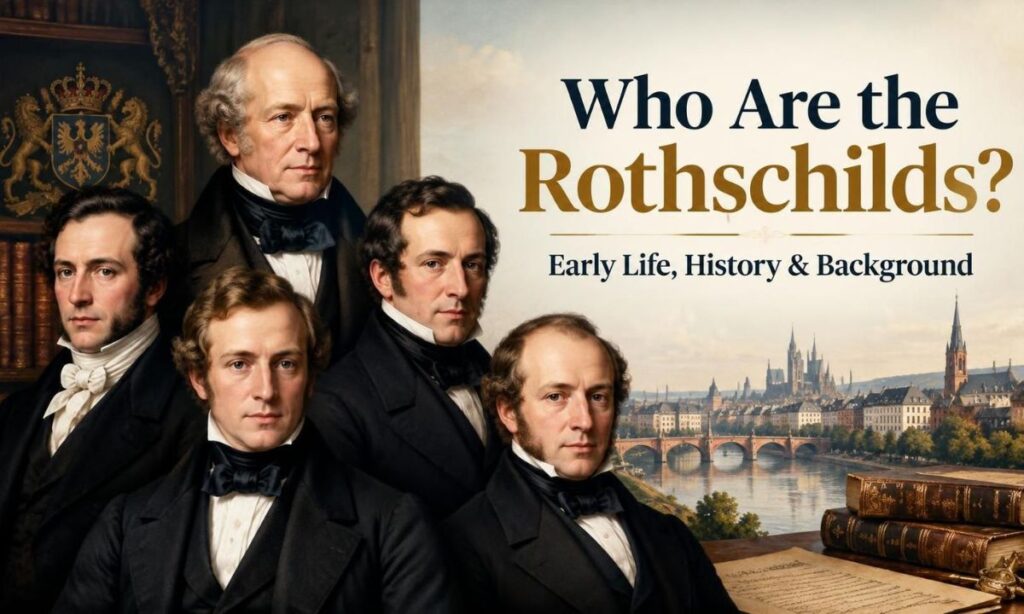
The institutional credibility of the family name traces back to Mayer Amschel Rothschild (1744–1812), who established a rare coin and banking business in the Judengasse ghetto of Frankfurt, Germany. Mayer Amschel strategically deployed his five sonsAmschel, Salomon, Nathan, Kalman, and Jakobto Europe’s premier financial capitals: London, Paris, Vienna, and Naples.
This sibling network created the world’s first international private banking partnership. By executing cross border sovereign bond issuances, financing major European infrastructure projects, and capitalizing on historical geopolitical turning points such as the Napoleonic Wars, the family transitioned from local merchant bankers into the preeminent financial power brokers of the 19th century.
Modern descendants inherited this foundation, transforming 19th century merchant banking roots into contemporary specialized private equity, corporate advisory, and wealth management services. Understanding the true scope of rothchilds net worth requires examining how these historical trade networks evolved into regulated, modern institutional structures.
Furthermore, the deliberate choice to distribute family members across sovereign borders insulated their enterprise from localized economic collapses, political revolutions, and regional taxation shifts, setting a permanent benchmark for globalized asset protection.
Career Timeline & Key Milestones
The 18th & 19th Century Merchant Foundation (1760–1900)
The Five Brothers Expansion across Europe
Following Mayer Amschel’s death, his sons took control of distinct European branches. Nathan Mayer Rothschild established N.M. Rothschild & Sons in London in 1804, while Jakob Mayer Rothschild founded Rothschild Frères in Paris. This decentralized framework allowed the family to arbitrage European sovereign debt, gold shipments, and commercial credit across borders more efficiently than any contemporary state institution.
Observers studying early industrial finance often look at the rothchilds net worth trajectory during this period as the blueprint for modern multinational corporate expansion.
Financing Sovereign Wars and the Waterloo Bond Legend
During the final campaigns against Napoleon, the London house coordinated massive remittances to fund British and allied troops across Europe. The legendary speed of Nathan’s courier network during the Battle of Waterloo cemented the family’s reputation for unmatched financial intelligence and market dominance.
20th Century Restructuring & Nationalizations (1900–1999)
Surviving the French Nationalization of 1981
The dynasty faced severe structural threats during the 20th century, culminating in 1981 when the socialist government of French President François Mitterrand nationalized the Paris based bank, Banque Rothschild.
Patriarch David de Rothschild subsequently rebuilt the French operation from scratch under the name Rothschild & Cie Banque, proving the resilience of the family’s brand capital over physical asset ownership.
The Re consolidation of London and Paris Operations
By the late 20th century, the separate English and French branches took steps to realign their global operations. This paved the way for a unified holding structure that eventually brought the historic merchant banking houses back under a single coordinated banner.
Modern Institutional Era & Global Wealth Management (2000–2026)
The 2018 Merger of Rothschild & Co
In recent years, the family streamlined its corporate governance. A landmark moment occurred when the Concordia holding entity executed a simplified tender offer to take Rothschild & Co private, delisting it from public exchanges in late 2023 to secure long term family stewardship away from public market volatility.
Pivot Toward Private Equity and Alternative Investments
Under modern executive leadership, the group heavily expanded its Five Arrows alternative investment arm and private wealth advisory divisions. By mid 2026, institutional metrics for Rothschild & Co reported assets under management surpassing €150 billion, alongside an additional €34 billion managed via alternative asset strategies.
This structural pivot heavily influences how modern analysts calculate the baseline rothchilds net worth across global advisory markets, shifting focus away from static cash reserves toward dynamic, fee generating advisory ecosystems.
Net Worth Breakdown by Income Source
Because the family fortune is distributed across hundreds of individual descendants and independent family offices, exact personal income figures are private. Financial analysts evaluate the dynasty’s ongoing economic generation through three primary pillars:
| Income Stream | Nature of Revenue | Estimated Impact |
| Private Banking & Advisory Fees | Corporate finance, M&A advisory, and wealth management fees earned via Rothschild & Co and Edmond de Rothschild Group. | Primary institutional revenue generator |
| Industrial Equity & Dividends | Direct public and private equity stakes held by individual heirs (e.g., Volex plc industrial manufacturing). | High yield private cash flow |
| Premier Wine & Real Estate | Operational revenue from legendary Bordeaux estates and agricultural holdings. | Inflation hedged tangible wealth |
Private Banking & Wealth Management Advisory Fees
Rothschild & Co and the Edmond de Rothschild Group operate as elite financial advisors to institutional clients, sovereigns, and ultra high net worth individuals. Advisory fees from global mergers, acquisitions, and asset management drive steady corporate revenues. For instance, the Edmond de Rothschild Group reported record asset inflows nearing CHF 200 billion in early 2026.
Industrial Equity Stakes & Corporate Dividends
Individual family members actively manage private investment vehicles. A prominent contemporary example is Nathaniel Philip Rothschild (the 5th Baron Rothschild), whose investment company NR Investments holds substantial industrial equity, including a significant beneficial interest of approximately 25.6% in British manufacturing firm Volex plc, generating consistent equity dividends.
These diversified cash flows contribute significantly to the stable accumulation of rothchilds net worth across generations, ensuring that lifestyle expenditures are funded by active portfolio performance rather than principal liquidation.
Premium Wine Estates & Agricultural Holdings
The family’s agricultural holdingsmost notably premier wine estates like Château Lafite Rothschild and Château Mouton Rothschild, produce high-value luxury goods that command robust global market prices, serving as historic stores of generational value.
Assets & Lifestyle: Real Estate, Vineyards, and Corporate Holdings

| Asset Category | Notable Holdings / Examples |
| Historic Real Estate | Waddesdon Manor (UK), historic Paris townhouses, various European country estates. |
| Premier Wine Estates | Château Lafite Rothschild, Château Mouton Rothschild, Château Clarke. |
| Public & Private Trusts | RIT Capital Partners (formerly Rothschild Investment Trust), private equity funds. |
Historic European Real Estate & Country Estates
Over centuries, the family commissioned iconic architectural masterpieces across Europe, such as Waddesdon Manor in Buckinghamshire, England, and various Parisian townhouses like the Hôtel Salomon de Rothschild. While many historic properties have been gifted to public trusts or universities (such as Château de Ferrières given to the University of Paris in 1975), private family offices maintain elite real estate portfolios globally.
Legendary Bordeaux Vineyards (Château Lafite & Mouton)
The family’s wine portfolio represents some of the most prestigious agricultural land on earth. Estates like Château Lafite Rothschild in Pauillac produce first growth wines that command elite collector prices at international auctions, acting as a tangible luxury asset class.
Public and Private Investment Trusts (RIT Capital Partners)
Historically associated with financial trusts like RIT Capital Partners (chaired for decades by the late Jacob Rothschild), the family utilizes diversified investment trusts to protect capital across public equities, government bonds, and venture capital. Examining these trusts provides clear insight into how the total rothchilds net worth remains shielded from macroeconomic downturns.
Net Worth Growth Over the Decades

Note: Institutional AUM figures are drawn from public corporate disclosures; individual family net worth metrics are estimates based on historic inheritance data and known equity holdings.
| Decade / Year | Estimated Institutional AUM / Corporate Scale | Key Structural Milestone |
| 1980 | ~26 billion francs (approx. $5B historical equivalent) | Pre nationalization Paris operations |
| 2010 | Multi billion global private banking network | Expansion of emerging market mining and energy investments |
| 2020 | €100B+ institutional asset footprint | Continued post crisis wealth management consolidation |
| 2026 | €150B+ (Rothschild & Co) / ~CHF 200B (Edmond de Rothschild) | Post delisting private restructuring & strategic capital growth |
Rothschilds vs. Rockefellers: Old Money Dynasty Comparison

| Name / Entity | Net Worth / Scale | Profession | Primary Income Source |
| The Rothschilds | Multi billion institutional AUM / distributed family trusts | International Banking & Wealth Management | Private banking advisory fees, asset management, and industrial equities |
| The Rockefellers | Multi billion multi generational family office scale | Industrialists & Philanthropists | Real estate, legacy oil equities, and diversified institutional trusts |
Public Image, Wealth Dilution, and the $500 Trillion Myth
The persistent internet rumor that the family controls a $500 trillion fortune stems from a fundamental misunderstanding of financial aggregation. Over more than two and a half centuries, the original fortune has been divided among hundreds of descendants across multiple generations.
Furthermore, conflating Assets Under Management (money managed on behalf of global institutional clients and pension funds) with personal family wealth inflates reality by orders of magnitude.
Modern descendants do not operate as an omnipotent central bank; instead, they function as independent institutional executives, private bankers, and philanthropic stewards operating within regulated modern financial markets. When researchers assess the actual rothchilds net worth, they separate client managed capital from private family equity, ensuring transparent and accurate financial reporting.
Frequently Asked Questions
How much are the Rothschilds actually worth in 2026?
There is no single official net worth figure for the entire Rothschild family because the wealth is decentralized among hundreds of living heirs. While institutional firms associated with the family manage well over €350 billion in combined client assets, individual modern heirs possess estimated net worths ranging from tens of millions to over $1 billion. When tracking financial data, the estimated rothchilds net worth reflects this fractured, multi generational distribution rather than a single massive pool of liquid cash.
What is the Rothschilds’ main income source today?
The family’s primary contemporary revenue sources include private banking advisory fees, global corporate finance, wealth management services provided by Rothschild & Co and the Edmond de Rothschild Group, and returns on industrial equity investments and luxury vineyards.
Is the Rothschild family worth $500 trillion?
No. The popular $500 trillion figure is an unverified internet myth. It misinterprets global client assets under management and ignores centuries of wealth dilution across hundreds of descendants and estate taxes.
What companies and banks do the Rothschilds own?
Prominent institutions associated with the family include Rothschild & Co, the Edmond de Rothschild Group, and legacy investment vehicles such as RIT Capital Partners. Individual family members also hold significant private equity and industrial shares, such as stakes in Volex plc.
Who is the richest living member of the Rothschild family?
Individual net worth figures for private family members are largely estimated. Prominent modern business figures like Nathaniel Philip Rothschild, who became the 5th Baron Rothschild, hold estimated individual fortunes around the $1 billion mark derived from hedge fund ventures and international industrial investments.
How did the Rothschild family build their initial fortune?
The fortune was founded in the late 18th century by Mayer Amschel Rothschild in Frankfurt, Germany. His five sons expanded the banking business across London, Paris, Vienna, and Naples, leveraging sovereign bond underwriting, government loans, and cross border currency logistics during the Napoleonic era. This foundational history established the long term baseline for the modern rothchilds net worth.
Final Thoughts
Evaluating the true financial footprint of Europe’s most famous banking dynasty requires stripping away sensationalized internet myths and examining verifiable corporate disclosures. Rather than holding an impossible centralized monopoly, the modern lineage thrives through institutional advisory, private equity stewardship, and disciplined capital preservation across hundreds of independent family branches.
Understanding these multi generational mechanisms provides an accurate framework for tracking old money wealth in today’s globalized economy.
