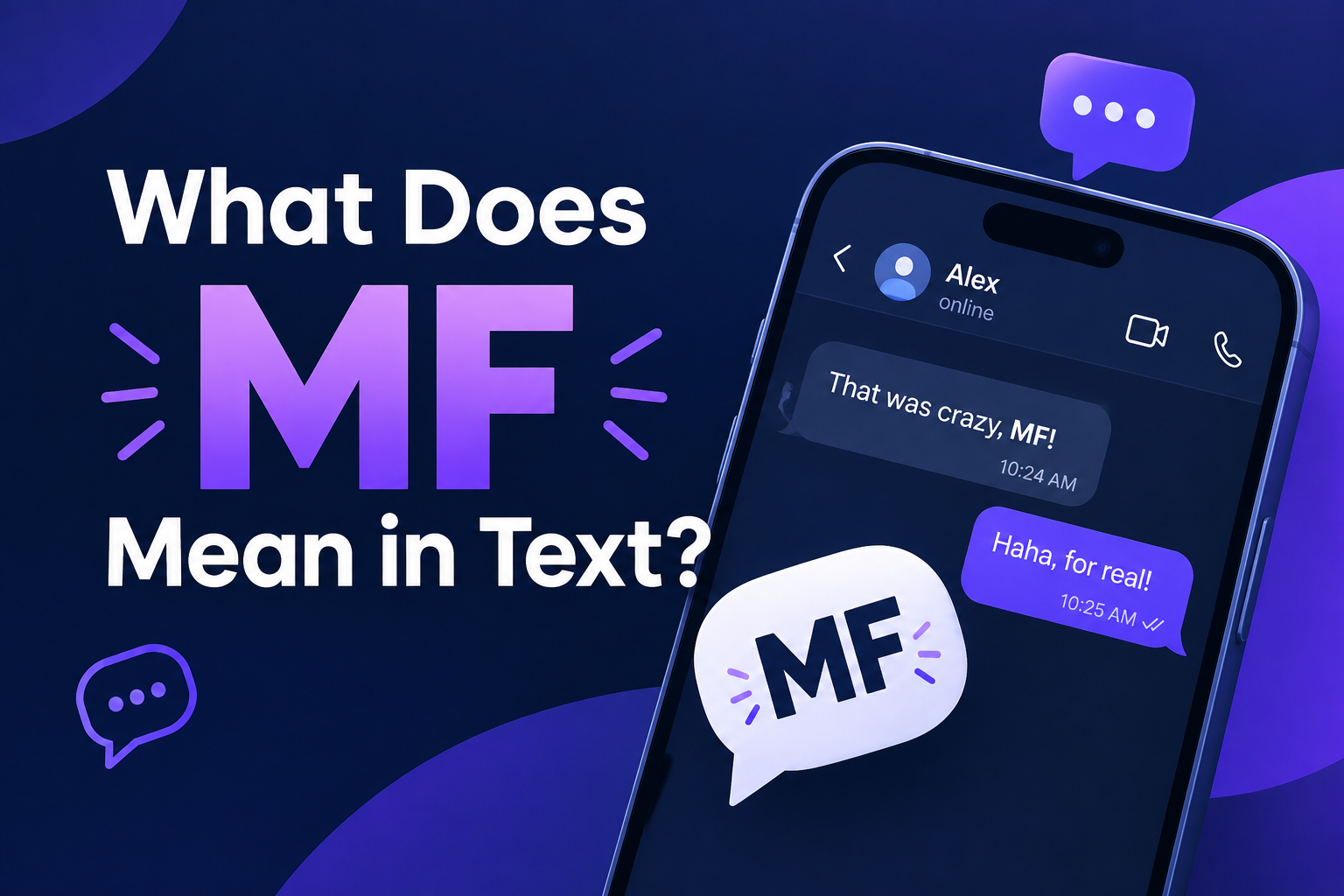
You are scrolling through a chat and someone writes “this MF is so funny.” Is that a joke, an insult, or both? If you have ever paused and wondered what does MF mean in text, you are not alone.
This guide gives you the short answer first, then explains where MF shows up, why people use it, and when you should skip it. You will also find real examples, a comparison with similar slang, and practical tips.
Quick Answer (Featured Snippet)
MF in text most often stands for “motherf***er.” People use it to add emphasis, show strong emotion, or joke around, depending on the tone. It can be playful between friends or rude when aimed at someone, so context decides everything.
Key takeaway: When you ask what does MF mean in text, the safest answer is “a strong, informal word for emphasis that can be friendly or offensive based on tone.”
What Does MF Mean in Text?
In text messages, chats, and comments, MF is an abbreviation of a strong swear word. It is the short, typed version of “motherf***er,” and most people understand it right away.
The word has moved far beyond its original harsh meaning. Today it often works as a loud punctuation mark. It tells the reader that the writer feels something intensely, whether that is love, anger, shock, or amusement.
Simple Meaning of MF
The simple meaning of MF is “a very strong way to describe a person or thing.” It can describe someone you admire, someone who annoyed you, or just a situation that surprised you.
Here is the easiest way to remember it:
- Friendly use: “You are the best MF I know.” It means you are really great.
- Angry use: “That MF cut me off.” It means you are upset with that person.
- Emphasis use: “I was tired MF.” It means extremely tired.
Where Is MF Used?
MF appears in almost every informal digital space. You will see it most in casual chats, social platforms, games, and meme pages, where people write fast and expect a relaxed tone.
Text Messages
In private texts, MF usually shows up between friends who already know each other’s humor. It adds punch to a story or a reaction, like “my brother MF forgot my birthday.”
Because there is no voice or face to read, the other person has to guess your tone. That is why it works best with people who know you well.
Social Media
On platforms like Instagram, X, TikTok, and Snapchat, MF is common in captions, comments, and replies. Creators use it to sound relatable and direct.
Online Gaming
Gamers use MF in voice chat and text chat during intense moments. It can be trash talk, a joke about a teammate, or a shout of excitement after a big win.
Gaming communities are often more relaxed about strong language, but many servers still ban it. Always check the rules first.
Memes and Internet Culture
Memes love MF because it adds comic exaggeration. A caption like “me when the Wi-Fi drops MF” turns a small annoyance into dramatic comedy.
Over time, the term has become a standard ingredient of internet humor, which is part of why it spreads so quickly.
Group Chats
Group chats are where MF feels most natural. Friends tease each other, react to news, and exaggerate for fun, so the word fits the mood.
The risk is when someone new joins or a family member sits in the chat. A joke that works with close friends may land badly with a mixed audience.
Why Do People Use MF?

People use MF because it makes a message feel stronger, funnier, or more honest. It packs a lot of feeling into two letters, and that is exactly what fast texting rewards.
To Add Emphasis
MF can act like a volume boost. Writing “that movie was long MF” sounds more vivid than “that movie was long.”
In this role, it does not point at anyone. It simply makes the sentence hit harder.
To Express Frustration
When something goes wrong, MF helps people vent. “This MF app crashed again” shows irritation faster than a long explanation.
The target here is usually an object or a situation, not a person.
To Show Surprise
People also use MF when something shocks them. “Wait, he actually won MF” captures disbelief in a very short line.
The tone is more like “wow” than “I am angry.”
To Joke Around
Among friends, MF is often playful teasing. Calling a buddy “you crazy MF” can be affectionate, similar to how people say “you clown.”
The joke only works when both people share the same sense of humor.
Real-Life Examples of MF in Text
Examples make the meaning much clearer. Here are five common ways MF appears, with the tone behind each one.
Example 1: Friendly Joke
“You ate the last slice again, you greedy MF.”
This is light teasing. The writer is not angry and probably follows it with a laughing emoji.
Example 2: Frustration
“This MF printer jammed right before my deadline.”
Here MF expresses annoyance at a thing. Nobody is being insulted, but the stress is real.
Example 3: Surprise
“She finished the whole marathon in under four hours MF.”
The word adds astonishment. It reads like an impressed “unbelievable.”
Example 4: Gaming Chat
“Who left the base open MF, we are getting wiped.”
This mixes frustration with urgency. Gaming chat often moves fast, so short strong words are common.
Example 5: Social Media Comment
“This singer is that MF good, I keep replaying it.”
Here MF is praise. It works like “seriously good,” which shows how flexible the term is.
Does MF Always Mean Motherf***er?
No, but it is the most common meaning by far. Because MF is only two letters, other phrases can share the same abbreviation depending on the setting.
If the chat is about money, music, or friends, the meaning may change. Always read the surrounding conversation before you decide.
Alternative Meanings of MF
| Meaning | Where it appears | Example |
|---|---|---|
| Motherf***er | Texts, social media, gaming | “That MF is hilarious.” |
| My Friend | Casual or friendly chats | “Thanks, MF!” (rare) |
| Mutual Friend | Social networks | “We have an MF in common.” |
| Mutual Fund | Finance talk | “I invested in an MF.” |
| Mezzo Forte (mf) | Music notation | A moderately loud passage |
The non-slang meanings are much less common in everyday texting. If someone sends MF with no finance or music context, assume the slang meaning.
MF vs Similar Text Slang
MF is stronger and more personal than most similar abbreviations. Here is how it compares with slang you may also see.
| Slang | Full form | Typical use | Strength |
|---|---|---|---|
| MF | Motherf***er | Emphasis, teasing, anger | High |
| AF | As f*** | Boosts an adjective, “tired AF” | Medium to high |
| WTF | What the f*** | Shock or confusion | Medium to high |
| FR | For real | Agreement or sincerity | Low |
| SMH | Shaking my head | Disappointment | Low |
Key Difference
The main difference is what the word attaches to. AF follows an adjective (“cold AF”), while MF usually attaches to a person or thing (“this MF”) or sits at the end of a sentence for extra punch.
When Should You Use MF?
Use MF only in informal conversations where everyone shares the same comfort level. If you are unsure, leave it out, because the cost of offending someone is higher than the benefit of sounding casual.
Good Situations
- Chatting with close friends who also swear casually
- Joking in a private group chat
- Reacting to a funny or shocking moment online with peers
- Playing games with people who enjoy trash talk
Example
Friend: “I got the concert tickets!” You: “No way, you lucky MF!”
This works because the tone is excited and the relationship is close.
When Should You Avoid Using MF?
Avoid MF whenever the reader might feel disrespected or when the setting is serious. A single misread message can damage trust, especially in professional or family contexts.
Avoid Using MF In:
- Work emails, Slack messages, and client chats
- School or college communication with teachers
- Messages to older relatives or people you barely know
- Any conversation where you are arguing or tensions are high
Better Alternative
Swap MF for a milder word that still carries energy. Try “seriously,” “super,” “insanely,” or “for real.” For example, “that was insanely good” keeps the excitement without the risk.
Common Misunderstandings About MF
Many people misread MF because they judge the word instead of the situation. These three mistakes cause most of the confusion.
MF Isn’t Always an Insult
People often assume MF is aggressive. In reality, it is frequently affectionate or admiring, as in “my best friend is a legend MF.”
Tone Changes the Meaning
The same two letters can be a hug or a slap. Emojis, punctuation, and the history between the two people tell you which one it is.
Not Everyone Appreciates It
Even if you mean it kindly, some readers will still find it crude. Respecting that preference is part of good communication.
Is MF Offensive?
It can be, but it depends on who reads it and where. MF is considered strong profanity, so it is not safe for every audience, even though many people use it casually.
Casual Use
Among friends and in relaxed online spaces, MF is usually seen as normal slang. People expect rough humor there and rarely take it personally.
If you want to see how it is explained for messaging apps.
Formal Settings
In workplaces, schools, and official communication, MF is inappropriate. It can be treated as unprofessional language and may even lead to warnings or complaints.
Cultural Differences
Attitudes vary by country, age group, and community. Something that sounds mild in one online group can feel shocking in another, especially for older readers or people from more conservative cultures.
Pro Tips for Using MF Correctly
If you choose to use MF, follow a few simple habits to avoid awkward moments. These tips keep your messages clear and respectful.
Understand the Context
Read the conversation before you type. If the mood is relaxed and others use similar language, MF will probably fit. If the mood is serious, hold back.
Know Your Audience
Think about who will read your message. Close friends may laugh, but a new colleague may not. Younger audiences also tend to be more comfortable with it.
Avoid Professional Communication
Keep MF out of anything that could be forwarded, screenshotted, or saved for records. Messages live longer than we expect.
Consider Alternatives
If you want the same energy with less risk, use words like “seriously” or “totally.” They keep your style casual without crossing a line.
Remember Tone Matters
Add a laughing emoji or a friendly follow-up when you are joking. A quick “haha” can turn a harsh-looking message into a clear joke.
Pro tip: If you would hesitate to say it out loud in front of the person, do not text it.
Frequently Asked Questions
What does MF mean in text messages?
In text messages, MF usually means “motherf***er.” It is used for emphasis, frustration, surprise, or friendly teasing. The tone and the relationship between the people decide whether it is playful or rude.
Is MF a bad word?
Yes, MF counts as strong profanity because it abbreviates a swear word. Many people use it casually with friends, but it is not suitable for formal, professional, or family settings.
Can MF be used as a compliment?
Yes, MF can be a compliment when the tone is warm. Saying “you are a talented MF” to a friend shows admiration. Still, make sure the person will take it that way.
What does MF mean in music?
In music notation, “mf” stands for “mezzo forte,” which means moderately loud. This is completely unrelated to the slang meaning. On the internet, the letters can also point to rap artists and fans.
What does MF mean on social media?
On social media, MF mostly works as an intensifier or a casual insult. You will see it in captions, memes, and comments to add attitude or humor. Occasionally it means “mutual friend” when people discuss followers.
Final Thoughts
So, what does MF mean in text? It is a strong, informal abbreviation that adds emphasis, humor, or emotion, and its meaning changes with tone and audience. Among close friends it can be warm and funny, while in formal settings it can be offensive.
Before you send it, think about who is reading and how they will feel. When in doubt, choose a milder word and let your message speak for itself.
